
What is ecotourism?
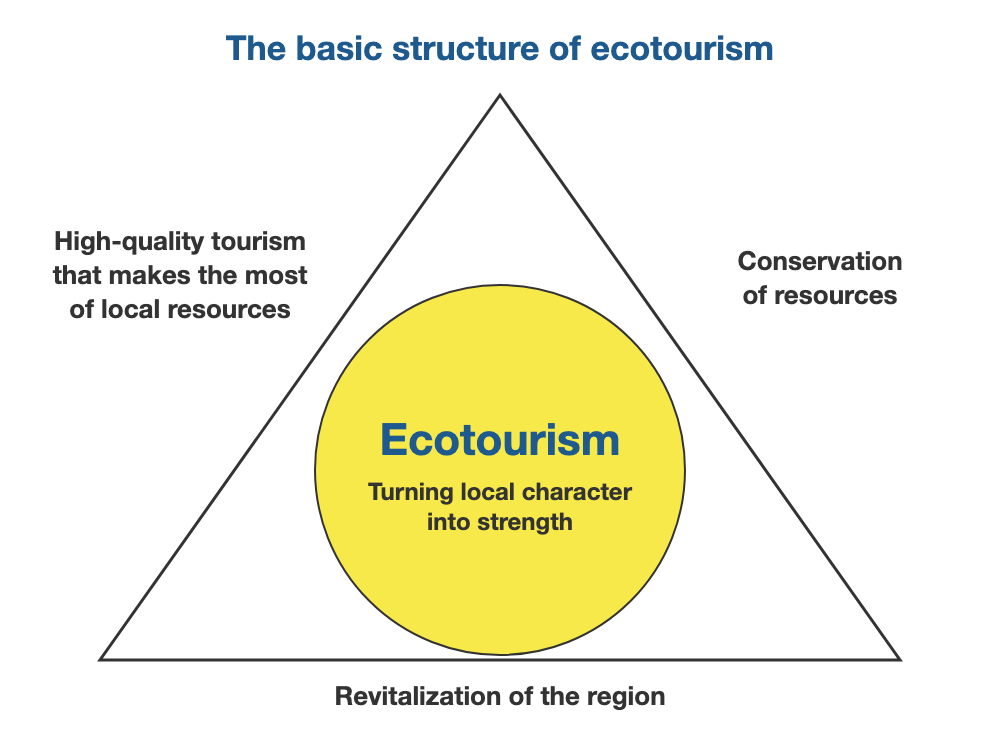
Ecotourism is a concept that spread internationally in the 1980s. It asks how to conserve and use resources sustainably, so that the precious resources found in each region can be protected together with local people, the local economy can be revitalized, and these resources can be handed down to children three generations from now. In Japan, the Ecotourism Promotion Act came into force in 2008, setting out the conservation of the natural environment, the promotion of tourism, regional development and environmental education as its goals.
Building on this idea, the concept shown by the triangle in the figure was developed in Japan. This is the basic structure of ecotourism.
Ecotourism is the way of thinking that makes all three possible at the same time.
The aims of ecotourism can be summarized in the following three points.
The aims of ecotourism
1. To create ripple effects for the local economy through the healthy continuation of local resources
2. To establish a tourism industry that makes use of the region’s own natural, cultural and historical resources
3. To manage, protect and conserve resources properly so that tourism does not damage them
Talk to us about your research needs
We welcome consultations on community development, marketing & social research and policy research, from the earliest planning stage.
Or call us at +81-3-5410-3391 (weekdays 10:00–18:00 JST)